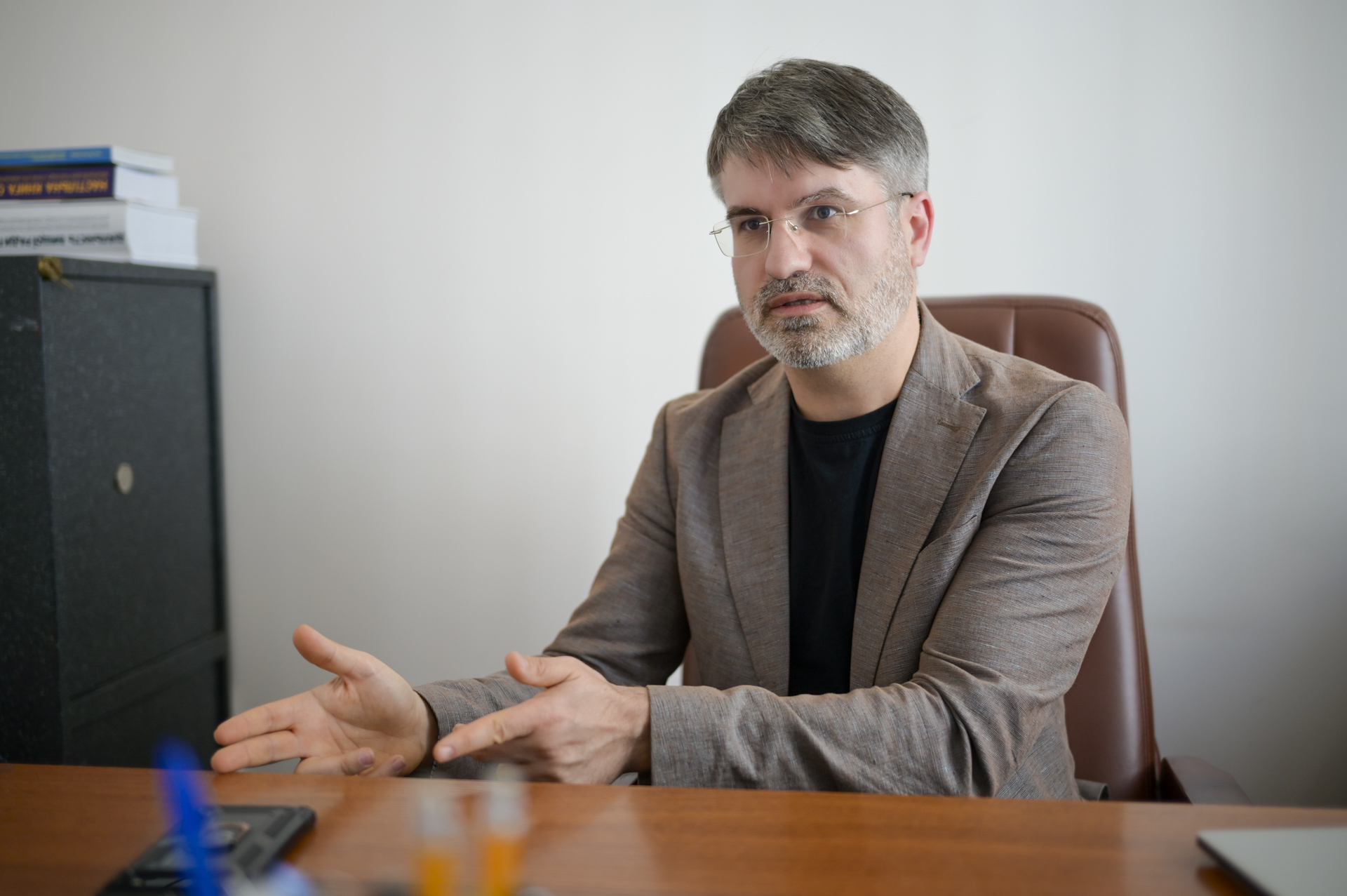
Roman Maselko is a former banking lawyer, active participant and legal defender of protesters during the Revolution of Dignity, and subsequently a complainant in numerous disciplinary cases against judges who, in his view, committed misconduct incompatible with judicial office.
In August 2022, the Verkhovna Rada elected him as a member of Ukraine’s primary judicial governance body — the High Council of Justice (HCJ), which handles judicial accountability, dismissals, and appointment recommendations. At that time, approximately 400 pending disciplinary complaints filed by him were awaiting review at the HCJ. During their adjudication, Maselko recuses himself and, in certain cases, appeals disciplinary chamber decisions in his capacity as a complainant.
“This ‘switching’ of roles is inherent to the legal profession. One day you represent a defendant opposing the prosecution, and the next day you represent victims supporting the charges. Naturally, everything must proceed strictly according to law. Moreover, the HCJ is a collegial body. I do not adjudicate complaints alone — that would be unacceptable. Nor is there any private interest of mine in these complaints; I filed them for the public good, for the cleansing of the judicial system,” he explains when asked about balancing these two roles.
On the necessity of introducing a public quota in the High Council of Justice, his position regarding the complaint against Kyiv Pechersk District Court judge Serhiy Vovk and the dismissal of former Supreme Court President Vsevolod Kniaziev, the timeline of judicial reform, the dispute within the Public Integrity Council, and his plans for the remaining months in office — in this in-depth interview by Watchers with Roman Maselko.

“The Disciplinary Review Process Itself Has Become Adversarial”
A substantial portion — roughly 80% of the HCJ’s workload — consists of disciplinary cases. When we resumed disciplinary reviews in November 2023, the backlog exceeded 20,000 complaints. By the time the Disciplinary Inspector Service was established in December 2024, over 10,000 complaints remained pending and were transferred to the service. On average, 8,000 to 9,000 new complaints arrive annually. To date, inspectors have reviewed over 6,000 complaints, with around 12,000 currently under review.
With the creation of the Disciplinary Inspector Service, the primary burden of preliminary preparation fell on them. Nonetheless, HCJ members must still analyze the materials prepared by disciplinary inspectors, and we are the ones making the final decisions, so our workload remains substantial.
However, the HCJ is not merely a body that reviews complaints against judges. It is the body of judicial governance. It effectively administers the judicial system: addressing strategic policies, allocating budget funding, responding to threats to judicial independence, and more.
The HCJ plays a major role in judicial appointments. Returning to your question about priorities, appointment submissions take precedence. Over the past year, we appointed around 500 judges. Currently, for instance, we have received HQCJ recommendations regarding appellate court appointments.
No, it remains roughly consistent. The only slight increase is in the number of opened disciplinary proceedings, as complaints were previously more frequently dismissed without review.
The review process itself has become truly adversarial. In the past, disciplinary chambers frequently reached decisions without summoning the parties or heard only the judge’s explanations. Today, we mandatory invite both the complainant and the judge, stream hearings live online, and preclude behind-the-scenes arrangements. Every party has the opportunity to present evidence and argue their case.
On Kniaziev: “I Thought This Person Could Become a Driver of Change in the System. But I Realized What He Was Actually Doing…”
For me, it was a massive shock and deep disappointment. I genuinely believed Kniaziev could be a driver of change and a leader of the new generation of judges. When audio recordings and proof of illicit benefits emerged, it became obvious that a widespread corruption network existed. Meanwhile, the HCJ’s response was uncompromising: we immediately granted consent to his custodial detention and subsequently resolved to dismiss him from judicial office for committing substantial disciplinary misconduct.
Almost all of them do. This is a normal legal process, although Grand Chamber rulings sometimes cause surprise when clear instances of abuse are overturned purely on procedural technicalities. Nonetheless, our duty is to formulate decisions of such high legal rigor that they withstand any judicial scrutiny.

“Today Nobody Has Influence Over the Formation of Either the HCJ or the HQCJ”
Although political influence on the HCJ is reduced to zero today — and I can say this with absolute certainty — informal contact attempts or media pressure campaigns still occur. However, thanks to the participation of international experts in selection commissions, transparent public broadcasts, and the independence of Council members, systemic influence by the executive branch or oligarchic groups on decision-making has been eliminated.
“I wish as many people took to the streets to defend the independence of judges as they do to support NABU and SAPO. After all, an independent judiciary is the ultimate guarantor of justice for every citizen.”
On the PIC-3 Dispute and DEJURE: “The Problem Lay in Differing Views on Funding and Secretariat Setup”
The Public Integrity Council is an indispensable institution of judicial reform. Having served in the first composition of the PIC, I know firsthand how challenging and responsible this work is. The conflict arose over different views regarding administration, donor funding, and secretariat organization. Nevertheless, I am genuinely glad that the fourth composition of the PIC was formed and is actively working with the HQCJ on judicial qualification assessments.
“The Term of Office for HCJ Members Should Be at Least Six Years”
First and foremost, to conclude ongoing disciplinary proceedings, establish consistent case law on holding judges accountable for integrity violations and abuses of power, and ensure the irreversibility of judicial digitalization.

Currently, I oversee the digitalization portfolio at the HCJ. We are implementing an electronic cabinet system, optimizing workflow, and advancing the subsystems of UJITS. Automating routine and administrative tasks will balance judicial workloads and ensure prompt access to court proceedings for all citizens.
“Four years for an HCJ member is actually quite brief. If we seek genuine institutional resilience and judicial independence, the term of office for Council members should be extended to at least six years without the right of re-election.”